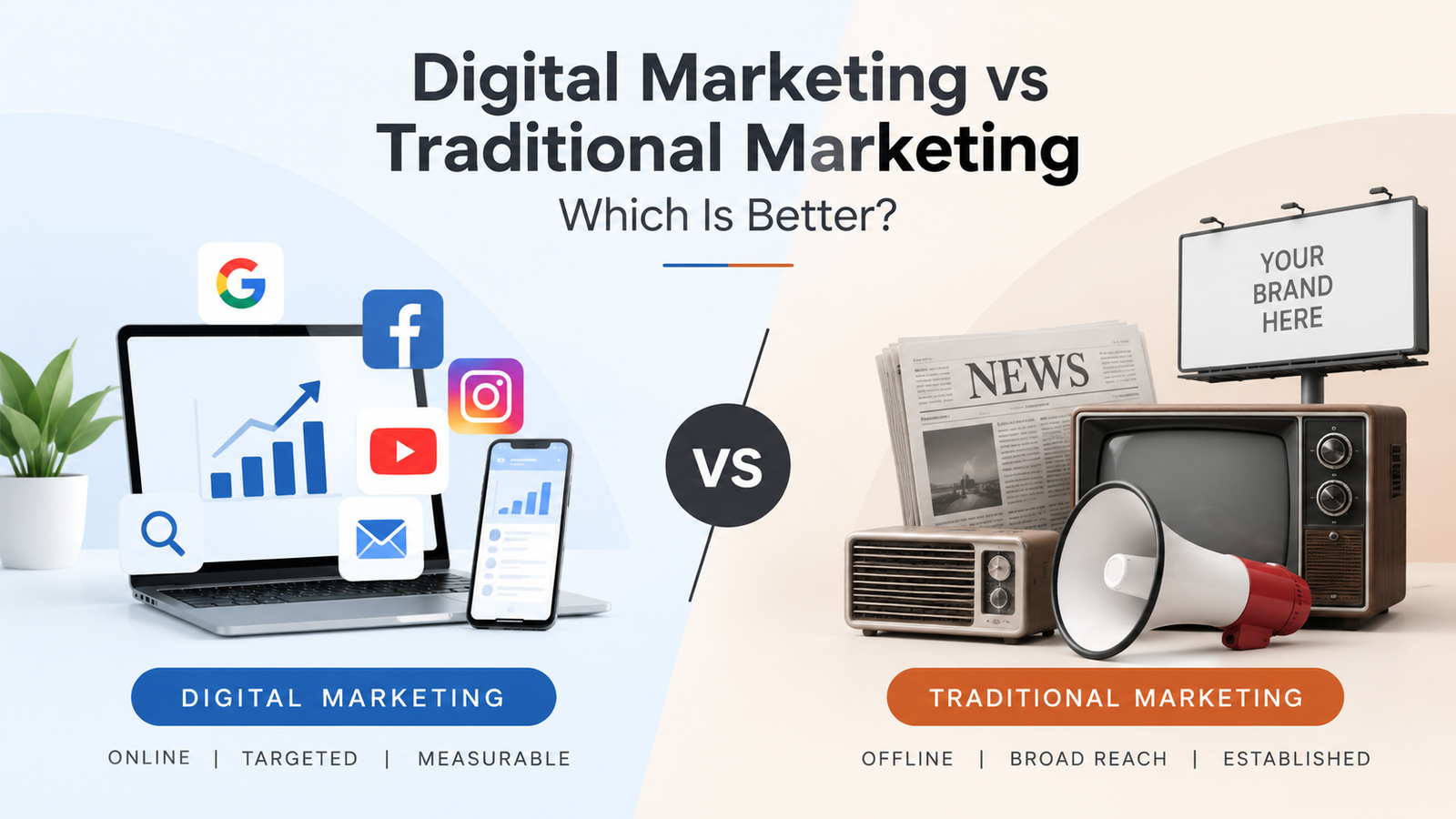
Digital Marketing vs Traditional Marketing: Which Is Better?
From AI integration to cross-platform fluency—discover the must-have technical and soft skills for today’s most in-demand dev roles.

by Satnam Singh
Digital Marketing vs Traditional Marketing: Complete Comparison Guide
Marketing has changed dramatically in the digital age, but traditional marketing is far from disappearing. From social media campaigns and Google Ads to television commercials and newspaper advertising, businesses today have more ways than ever to reach potential customers.
So, when comparing digital marketing vs traditional marketing, which one is better? The answer depends on your audience, goals, budget, industry, and how you want to measure results. Understanding the differences can help business owners, students, and aspiring marketers make smarter decisions—and help you choose the right marketing career path.
What Is Digital Marketing?
Digital marketing refers to promoting products, services, brands, or businesses through internet-connected channels and digital technologies.
It allows businesses to reach audiences through platforms they use every day, including search engines, websites, social networks, email, mobile devices, and online video platforms.
Common types of digital marketing include:
- Search Engine Optimization (SEO)
- Search engine marketing (SEM)
- Pay-per-click (PPC) advertising
- Social media marketing
- Content marketing
- Email marketing
- Affiliate marketing
- Influencer marketing
- Video marketing
- Mobile marketing
- Marketing automation
For example, an online education company might publish an SEO-optimized article targeting “best online certifications,” promote it through social media, and use email marketing to nurture visitors into potential customers.
The major advantage is that many digital campaigns can be tracked, measured, tested, and optimized in real time.
What Is Traditional Marketing?
Traditional marketing includes promotional methods that existed before the widespread adoption of the internet.
These channels can include:
- Television advertising
- Radio advertising
- Newspapers
- Magazines
- Billboards
- Direct mail
- Brochures and flyers
- Outdoor advertising
- Print catalogs
- Events and trade shows
For example, a local university might advertise an upcoming admissions program through newspaper advertisements, billboards, radio spots, and printed brochures.
Traditional marketing can be particularly useful when businesses want to reach audiences through physical locations, broadcast media, or established offline channels.
Digital Marketing vs Traditional Marketing: Key Differences
The most important differences become easier to understand when the two approaches are compared across several marketing factors.
| Factor | Digital Marketing | Traditional Marketing |
|---|---|---|
| Primary channels | Search engines, websites, social media, email | TV, radio, newspapers, magazines, billboards |
| Audience targeting | Highly customizable | Generally broader |
| Performance tracking | Extensive digital analytics | Often more difficult to measure precisely |
| Campaign changes | Can often be changed quickly | Changes may require additional production |
| Geographic reach | Local to global | Local, regional, or national depending on channel |
| Customer interaction | Often immediate and interactive | Usually more one-way |
| Content lifespan | Can remain searchable for months or years | Often tied to campaign duration |
| Personalization | High potential | Generally more limited |
| Lead generation | Strong online conversion options | Often relies on offline response mechanisms |
| Skill requirements | SEO, analytics, content, advertising, technology | Media buying, advertising, branding, sales |
Neither approach is automatically suitable for every organization. The right marketing comparison depends on what a company is trying to accomplish.
Reach and Audience Targeting
One of the biggest differences between digital and traditional marketing is how audiences can be reached.
Digital Marketing
Online marketing allows advertisers and content creators to target audiences using factors such as:
- Search behavior
- Demographics
- Geographic location
- Interests
- Website interactions
- Previous engagement
- Purchase behavior
- Device usage
For example, an online certification provider can create content specifically for professionals searching for project management courses.
Traditional Marketing
Traditional channels can provide broad exposure.
A television commercial, billboard, or newspaper advertisement can potentially reach thousands or millions of people, depending on the publication or media channel.
However, identifying exactly which individuals interacted with the advertisement can be more difficult.
Key takeaway: Digital marketing generally provides more granular audience targeting, while traditional marketing can provide broad offline exposure.
Cost Comparison: Digital Marketing vs Traditional Marketing
Marketing costs vary significantly by industry, platform, location, audience, and campaign size.
Digital marketing can be attractive to smaller businesses because marketers can often start with relatively controlled budgets.
For example, a company can:
- Publish organic content.
- Optimize pages for SEO.
- Build an email list.
- Test small paid advertising campaigns.
- Increase spending when campaigns generate acceptable results.
Traditional campaigns can involve significant production and distribution costs, particularly for television, print, direct mail, and large outdoor campaigns.
However, cost should not be confused with value.
A $500 digital campaign is not automatically better than a $5,000 traditional campaign. The important question is what business result each campaign generates.
Measurement and Analytics
This is one of the strongest advantages of digital marketing.
Digital campaigns can use analytics platforms and advertising dashboards to monitor metrics such as:
- Website traffic
- Click-through rate
- Conversion rate
- Cost per click
- Cost per acquisition
- Leads generated
- Email open rates
- Engagement
- Revenue attributed to campaigns
Marketers can then use this information to make changes.
For example, imagine an online course provider runs two landing pages:
Landing Page A: 1,000 visitors → 20 enrollments
Landing Page B: 1,000 visitors → 45 enrollments
The business can analyze the differences and potentially allocate more traffic toward the higher-converting experience.
Traditional advertising can also be measured, but measurement often relies on methods such as surveys, coupon codes, dedicated phone numbers, footfall studies, or media measurement systems.
Speed and Flexibility
Digital marketing campaigns can often be launched and modified quickly.
A marketer can:
- Change an advertisement headline
- Pause an underperforming campaign
- Update website content
- Test different landing pages
- Adjust keyword targeting
- Publish new social content
- Change email messaging
Traditional advertising can require more planning and production.
For example, changing a newspaper advertisement after it has been printed is obviously different from editing a digital advertisement before the next campaign cycle.
This flexibility makes online marketing particularly useful for businesses operating in rapidly changing markets.
Customer Engagement
Traditional advertising has historically been more one-directional.
A company broadcasts a message through television, radio, print, or outdoor advertising.
Digital marketing can create two-way communication.
Customers can:
- Comment on social media posts
- Respond to emails
- Leave reviews
- Ask questions
- Share content
- Participate in online communities
- Chat with businesses
- Watch videos and interact with content
This interaction can help businesses understand customer questions, preferences, and objections.
Trust and Brand Awareness
Traditional marketing can still play an important role in brand awareness.
Seeing a company’s name repeatedly on billboards, television, radio, or print publications can contribute to familiarity.
Digital marketing also supports brand building through:
- Educational content
- Social media
- Video
- Podcasts
- Online reviews
- Thought leadership
- Search visibility
- Online communities
For many businesses, combining offline brand awareness with digital engagement can create a broader customer journey.
Which Marketing Approach Is Better for Small Businesses?
For small businesses, the answer depends on their customers and business model.
A local restaurant might benefit from a combination of:
- Local SEO
- Google Business Profile optimization
- Social media
- Online reviews
- Local flyers
- Community events
An online software company may place greater emphasis on:
- SEO
- Content marketing
- Search advertising
- Email marketing
- Webinars
- Marketing automation
A local retail business could combine digital advertising with storefront signage and traditional promotional materials.
The important principle is to choose marketing channels based on where your customers actually spend their time.
Digital Marketing vs Traditional Marketing for Career Opportunities
The comparison isn’t only relevant to businesses. It also matters if you’re considering a marketing career.
Digital marketing has created specialized career paths across technology, content, advertising, analytics, and communications.
Digital Marketing Careers
Some common roles include:
- SEO Specialist
- Digital Marketing Executive
- PPC Specialist
- Social Media Manager
- Content Strategist
- Email Marketing Specialist
- Marketing Analyst
- Performance Marketing Manager
- Digital Marketing Manager
- Marketing Automation Specialist
These positions can require a combination of creative, analytical, and technical skills.
Traditional Marketing Careers
Traditional marketing can lead to roles such as:
- Brand Manager
- Advertising Executive
- Media Planner
- Public Relations Specialist
- Marketing Coordinator
- Print Advertising Specialist
- Event Marketing Manager
- Sales Promotion Manager
Many modern marketing positions combine traditional and digital responsibilities.
Skills You Need for a Digital Marketing Career
If you’re interested in building a career in digital marketing, consider developing skills in several areas.
1. SEO
Learn how search engines discover and rank content, including:
- Keyword research
- Technical SEO
- On-page optimization
- Link building
- Search intent
- Content optimization
2. Content Marketing
Learn how to create useful content that attracts and educates audiences.
This can include:
- Blog posts
- Videos
- Guides
- Infographics
- Social media content
- Email campaigns
3. Analytics
Data-driven marketing requires an understanding of metrics and measurement.
Learn how to interpret:
- Traffic
- Engagement
- Conversions
- Customer acquisition costs
- Campaign performance
4. Paid Advertising
Understand how platforms such as search engines and social networks enable businesses to reach targeted audiences.
5. Communication
Marketing is ultimately about communicating value clearly.
Strong writing, presentation, storytelling, and interpersonal skills can therefore remain important regardless of the marketing channel.
Is Traditional Marketing Becoming Obsolete?
Not necessarily.
Traditional marketing continues to have applications in industries and situations where offline exposure is valuable.
Consider:
- A billboard near a retail location
- Radio advertising for a local service
- Printed materials at an event
- Television advertising for a mass-market product
- Direct mail for a specific customer segment
- Trade shows for B2B businesses
At the same time, businesses increasingly use digital channels to support customer research, communication, and conversion.
Rather than treating digital marketing vs traditional marketing as an either-or decision, marketers can consider how the two approaches work together.
Can Digital and Traditional Marketing Work Together?
Absolutely.
An integrated marketing strategy can connect offline and online experiences.
For example, a company launches a billboard campaign with a memorable website address or QR code.
A potential customer sees the billboard, visits the website, reads educational content, subscribes to an email list, and eventually purchases a product.
The customer journey therefore moves across multiple marketing channels.
Another example is a university promoting an education program through a combination of:
Traditional channels
- Print brochures
- Campus events
- Outdoor advertising
Digital channels
- SEO
- Search advertising
- Social media
- Email marketing
- Online webinars
This integrated approach can help businesses maintain consistency across different customer touchpoints.
How to Choose Between Digital and Traditional Marketing
Before selecting a marketing channel, ask these questions:
1. Who is your target audience?
Understand their age, location, interests, purchasing behavior, and preferred communication channels.
2. What is your objective?
Are you trying to:
- Generate leads?
- Increase sales?
- Build awareness?
- Promote an event?
- Launch a product?
- Increase website traffic?
- Build a long-term brand?
3. How will you measure success?
Define measurable KPIs before launching a campaign.
4. What resources do you have?
Consider:
- Budget
- Staff
- Expertise
- Technology
- Content production capabilities
5. Does your customer journey happen online or offline?
If customers frequently research products online before purchasing, digital channels may play an important role.
If purchasing decisions depend heavily on physical locations or local awareness, offline marketing may remain valuable.
The Future of Marketing
The marketing industry continues to evolve as technology changes how businesses communicate with customers.
Important areas for marketers to understand include:
- Artificial intelligence
- Marketing automation
- Search engine optimization
- Data analytics
- Personalization
- Video marketing
- Social commerce
- Customer relationship management
- First-party data
- Omnichannel marketing
For students and professionals, this means continuous learning is increasingly important.
A successful marketing career can require more than learning one platform. Building transferable skills in strategy, communication, analytics, technology, and customer research can help professionals adapt as marketing channels change.
Final Thoughts: Digital Marketing vs Traditional Marketing
The digital marketing vs traditional marketing debate doesn’t have one universal answer.
Digital marketing offers extensive opportunities for online audience targeting, measurement, experimentation, and direct engagement. Traditional marketing continues to provide valuable channels for offline awareness, broad exposure, events, print, broadcast, and physical experiences.
The right approach depends on the audience, objectives, industry, budget, customer journey, and available resources.
For aspiring marketers, learning both approaches can provide a broader understanding of how modern businesses attract, engage, and retain customers.
Whether you’re exploring SEO, social media, content marketing, advertising, analytics, or broader business skills, continuous education can help you build practical knowledge for an evolving industry.
Ready to develop your marketing skills? Explore more courses, certifications, career resources, and professional learning guides on eLearningsHub.com and continue building skills that can support your next career opportunity.