The Complete Guide to Marketing & Sales Courses Online in 2026
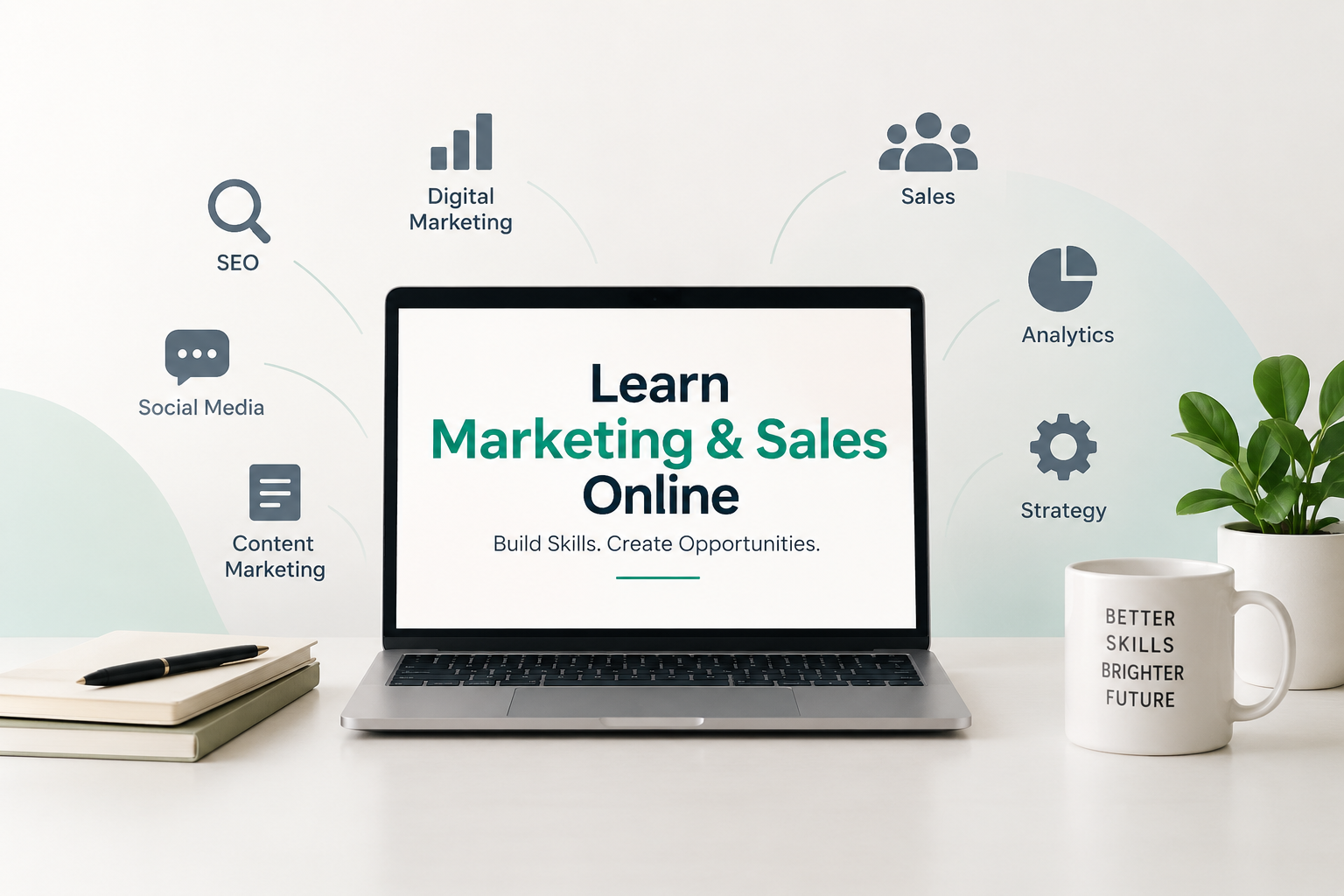
From AI integration to cross-platform fluency—discover the must-have technical and soft skills for today’s most in-demand dev roles.

by Satnam Singh
Marketing and sales are no longer skills reserved for traditional business professionals. Whether you are a student, entrepreneur, job seeker, freelancer, or experienced professional, learning marketing and sales online can open doors to new career opportunities and business growth.
From digital marketing courses and SEO to sales training, CRM, social media, content strategy, and marketing analytics, online education makes it possible to build practical skills at your own pace.
But with thousands of options available, how do you know which course is worth your time and money?
This complete guide explains how to choose the right online marketing courses, sales courses online, marketing certification programs, and marketing classes online in 2026.
Why Learn Marketing and Sales Online in 2026?
The way businesses attract, engage, and convert customers continues to evolve. Companies increasingly rely on digital channels, customer data, automation, social media, search engines, email, CRM platforms, and online advertising.
That means professionals need more than theoretical business knowledge.
They need practical, measurable, and continuously updated skills.
Online learning can be particularly useful because you can:
- Learn at your own pace
- Study around work or college
- Develop specialized skills
- Build a portfolio while learning
- Prepare for industry certifications
- Learn from experienced practitioners
- Update your knowledge without returning to full-time education
For example, someone interested in SEO can begin with keyword research and on-page optimization before progressing into technical SEO, analytics, content strategy, and AI-assisted workflows.
Similarly, someone entering sales can start with prospecting and communication before learning CRM systems, lead qualification, pipeline management, negotiation, and sales analytics.
What Are the Best Online Marketing Courses to Consider?
There is no single “best” marketing course for everyone.
The right choice depends on your career objective, current skill level, preferred specialization, budget, and the type of work you want to perform.
1. Digital Marketing Courses
A digital marketing course is a strong starting point for beginners who want broad exposure to online marketing.
A comprehensive program may cover:
- Search engine optimization (SEO)
- Search engine marketing (SEM)
- Social media marketing
- Content marketing
- Email marketing
- Online advertising
- Conversion rate optimization
- Marketing analytics
- Affiliate marketing
- Influencer marketing
- Marketing automation
This type of course is particularly useful for students, entrepreneurs, freelancers, and aspiring digital marketers.
2. SEO Courses
SEO remains an important skill for anyone working with websites and organic search.
An SEO course may teach:
- Keyword research
- Search intent
- On-page SEO
- Technical SEO
- Link building
- Local SEO
- Content optimization
- Google Search Console
- SEO analytics
- Content strategy
A good SEO learning path should combine concepts with practical exercises rather than focusing only on definitions.
3. Social Media Marketing Courses
Social media marketing courses help learners understand how brands use platforms to build awareness, engage communities, generate leads, and support sales.
Look for courses covering:
- Social media strategy
- Content planning
- Audience research
- Short-form video
- Community engagement
- Paid social advertising
- Social analytics
- Influencer campaigns
The most useful programs should teach learners how to create and evaluate an actual social media campaign.
4. Content Marketing Courses
Content marketing focuses on creating useful information that attracts and supports potential customers.
A good course can cover:
- Content strategy
- Audience personas
- Topic research
- Blogging
- Copywriting
- Content distribution
- SEO content
- Lead generation
- Content performance measurement
Content marketing is especially valuable for writers, SEO professionals, founders, and marketing managers.
5. Marketing Analytics Courses
Modern marketing decisions increasingly depend on data.
Marketing analytics training can help learners understand:
- Traffic sources
- Conversion rates
- Customer acquisition
- Campaign performance
- Engagement metrics
- Attribution
- Marketing funnels
- ROI measurement
If you already understand basic marketing, analytics can be an excellent next skill to develop.
What Do Sales Courses Online Teach?
While marketing focuses heavily on attracting and nurturing potential customers, sales focuses on converting opportunities into customers and revenue.
Sales courses online can range from beginner communication programs to advanced enterprise sales training.
Common topics include:
- Prospecting
- Lead generation
- Lead qualification
- Cold calling
- Email outreach
- Discovery calls
- Consultative selling
- Objection handling
- Negotiation
- Closing techniques
- Account management
- CRM management
- Sales forecasting
- Pipeline management
Beginner Sales Training
Beginners should look for sales classes that teach the fundamentals of customer communication.
A strong beginner curriculum may include:
- Understanding customer needs
- Identifying qualified prospects
- Starting sales conversations
- Asking effective discovery questions
- Presenting solutions
- Handling objections
- Following up professionally
- Closing and documenting the sale
The goal is not simply to memorize scripts. It is to understand why customers buy and how sales professionals create value.
Advanced Sales Training
Experienced sales professionals can benefit from programs focused on:
- Enterprise sales
- B2B selling
- Account-based selling
- Strategic account management
- Sales leadership
- Negotiation
- Revenue operations
- Sales forecasting
- CRM optimization
These skills are particularly relevant to account executives, sales managers, business development representatives, founders, and revenue leaders.
Marketing vs. Sales Courses: Which Should You Choose?
Marketing and sales overlap, but they are not identical.
| Marketing Courses | Sales Courses |
|---|---|
| Focus on attracting audiences | Focus on converting prospects |
| SEO and content | Prospecting |
| Social media | Lead qualification |
| Paid advertising | Discovery calls |
| Email campaigns | Negotiation |
| Brand awareness | Closing |
| Marketing analytics | Pipeline management |
| Customer acquisition | Revenue generation |
If you enjoy content, creativity, data, communication, and audience research, marketing may be a natural fit.
If you enjoy communication, persuasion, relationship building, negotiation, and measurable targets, sales may be more suitable.
You can also learn both.
In fact, understanding both sides can be particularly valuable for entrepreneurs and professionals working in small businesses where marketing and sales responsibilities often overlap.
How to Choose the Right Marketing Certification
A marketing certification can demonstrate that you have completed structured training and developed knowledge in a specific area.
However, certification alone should not be your only selection criterion.
Before enrolling, evaluate:
Course Curriculum
Check whether the curriculum matches your career objective.
For example, an aspiring SEO specialist should look for SEO, analytics, technical optimization, search intent, and content strategy rather than a course focused primarily on social media.
Practical Projects
Prioritize courses that include:
- Campaign exercises
- Case studies
- Portfolio projects
- Real-world scenarios
- Assignments
- Assessments
Practical experience makes it easier to demonstrate your skills to employers or clients.
Instructor Experience
Research the instructor’s professional background.
Look for educators with relevant industry experience rather than relying only on impressive course descriptions.
Certification Value
Not all certificates carry the same recognition.
Consider whether the certification comes from:
- A recognized technology company
- An established educational institution
- A respected professional organization
- A reputable training provider
Also check whether the certification has an expiration date or renewal requirement.
Course Reviews and Updates
Marketing changes quickly.
A course created several years ago may contain outdated approaches, tools, or platform recommendations.
Look for recently updated courses and reviews that discuss the actual learning experience.
Popular Official Learning Resources for Marketing and Sales
Learners can supplement paid marketing classes online with official educational resources.
Google Skillshop provides online training for Google products, including Google Ads, Google Analytics, and other marketing-related tools. Google also offers Google Ads certification paths through Skillshop.
HubSpot Academy offers free online marketing and sales training, including digital marketing, content marketing, social media marketing, inbound marketing, inbound sales, and other certifications.
Salesforce Trailhead provides free, online, hands-on learning through its Trailhead platform, including learning relevant to marketing, sales, CRM, and business roles.
These resources can complement a structured course by helping learners practice specific platforms and skills.
What Skills Should You Learn Alongside Marketing?
The strongest marketing professionals increasingly combine traditional marketing knowledge with technical and analytical skills.
Consider developing:
SEO + Analytics
Learn how to optimize content and then measure its performance.
Content + AI
Learn how to use AI tools for research, ideation, workflow automation, and content analysis while maintaining human judgment, originality, and quality.
Advertising + Conversion Optimization
Understanding paid traffic is useful, but knowing how landing pages and conversion funnels work makes advertising knowledge more valuable.
Marketing + CRM
Understanding how leads move from marketing campaigns into a CRM can help bridge the gap between marketing and sales.
Marketing + Data
Basic spreadsheet, analytics, reporting, and visualization skills can make marketing decisions more evidence-based.
How to Build a Marketing Career Through Online Learning
Completing course after course without applying what you learn can lead to certificate collecting rather than genuine skill development.
Instead, follow a practical learning cycle:
Learn → Practice → Build → Measure → Improve
For example, if you are learning SEO:
Step 1: Study keyword research.
Step 2: Select a real website or create a practice project.
Step 3: Build a keyword map.
Step 4: Optimize several pages.
Step 5: Track performance.
Step 6: Document what you changed and what happened.
You now have something more valuable than a certificate alone: evidence of practical ability.
How to Build a Sales Career Through Online Learning
Sales learners can use a similar approach.
Create a simulated sales process involving:
- An ideal customer profile
- Prospect list
- Outreach email
- Discovery-call questions
- Qualification framework
- Objection-handling scenarios
- Proposal
- Follow-up sequence
- CRM pipeline
Practice the process repeatedly.
You can even record mock sales calls and review your communication, questioning, listening, and objection-handling skills.
How Much Time Should You Spend on Online Courses?
There is no universal number of hours required to become proficient.
Instead of asking, “How quickly can I finish this course?” ask:
“How quickly can I apply what I learn?”
A practical weekly schedule might look like:
| Learning Activity | Suggested Focus |
|---|---|
| Course lessons | 30–40% |
| Practical projects | 30–40% |
| Research and reading | 10–20% |
| Review and assessment | 10% |
Even 30–60 minutes of focused learning per day can produce meaningful progress when maintained consistently.
Common Mistakes to Avoid When Choosing Online Courses
Choosing Based Only on Price
Free does not automatically mean poor quality, and expensive does not automatically mean better.
Evaluate curriculum, instructor expertise, practical learning, support, certification, and outcomes.
Collecting Too Many Certificates
Five certificates without practical experience may be less useful than one relevant certification supported by a strong portfolio.
Ignoring Practical Work
Marketing and sales are skill-based disciplines.
Practice matters.
Learning Outdated Tactics
Avoid courses that rely heavily on outdated SEO, advertising, social media, or sales techniques.
Trying to Learn Everything at Once
Start with one core skill.
Once you have a foundation, add complementary skills.
A Practical 90-Day Marketing and Sales Learning Roadmap
If you are starting from scratch, consider this simple roadmap.
Days 1–30: Build the Foundation
Learn:
- Marketing fundamentals
- Customer journey
- Target audiences
- SEO basics
- Content marketing
- Sales fundamentals
- Lead qualification
Days 31–60: Develop Practical Skills
Choose one primary specialization.
For example:
Marketing path: SEO + content + analytics
Advertising path: Paid search + paid social + conversion optimization
Sales path: Prospecting + CRM + discovery + negotiation
Complete practical assignments alongside your course.
Days 61–90: Build Your Portfolio
Create two or three projects demonstrating your skills.
Examples include:
- SEO audit
- Content strategy
- Social media campaign
- Google Ads campaign simulation
- Email marketing funnel
- Sales outreach sequence
- CRM pipeline
- Lead-generation campaign
Document your process and results.
This portfolio can become useful when applying for jobs, freelancing, internships, or client projects.
Final Thoughts: Keep Learning, Keep Applying
The best online marketing courses and sales courses online are not necessarily the longest or most expensive programs.
They are the ones that help you build skills you can actually use.
Whether your goal is to become a digital marketer, SEO specialist, sales executive, business development professional, entrepreneur, marketing analyst, or growth specialist, online education can help you build a structured path toward that goal.
Start with one skill. Choose a quality course. Practice consistently. Build real projects. Earn relevant certifications where they add value. Then keep expanding your skill set.
Ready to take the next step? Explore eLearningsHub.com to discover learning resources, compare courses, explore professional certifications, and find opportunities to build the skills that can move your career forward.

